US-China Trade War: Will Tariffs See a 15% Hike Next Quarter?
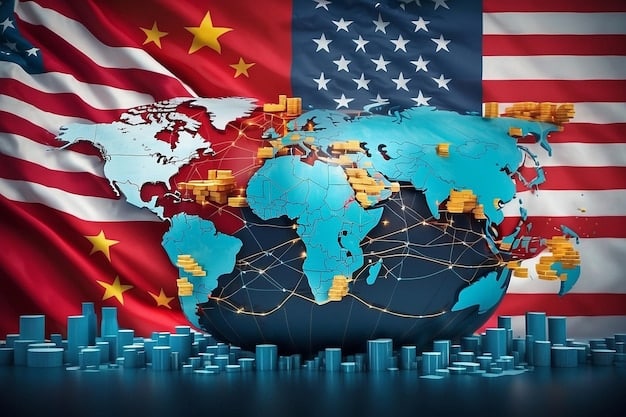
The US and China trade war outlook for a 15% tariff increase next quarter remains highly uncertain, contingent on ongoing geopolitical tensions, economic indicators, and evolving diplomatic negotiations between the two economic superpowers, with no definitive public statements confirming such a significant escalation.
The intricate dance between the world’s two largest economies, the United States and China, continues to captivate global attention, particularly regarding the persistent question of future trade relations. In this dynamic landscape, a pivotal concern looms: The US and China Trade War: Will Tariffs Increase by 15% in the Next Quarter? Navigating this complex inquiry requires a deep dive into historical context, present economic realities, and the myriad of factors influencing policy decisions.
Understanding the Genesis of the US-China Trade War
The trade friction between the United States and China didn’t emerge overnight; it’s a culmination of decades of evolving economic relationships and underlying disputes. Rooted in concerns over trade imbalances, intellectual property theft, forced technology transfers, and state subsidies, the tariffs imposed by both nations marked a significant shift in global trade dynamics. This period has been characterized by cycles of escalation and de-escalation, each phase impacting global supply chains and economic stability.
Initially, the US government, under the Trump administration, argued that China’s trade practices were unfair and detrimental to American businesses and workers. This led to the imposition of tariffs on billions of dollars worth of Chinese goods, prompting retaliatory measures from Beijing. The goal, as stated by the US, was to level the playing field and address long-standing grievances, though the economic ramifications extended far beyond the immediate trade partners.
Phases of Tariff Implementation
The trade war unfolded in several distinct phases, each introducing new layers of complexity. From the initial imposition of tariffs on steel and aluminum to broader categories of goods, the scope of the dispute widened progressively. This phased approach often left businesses in limbo, struggling to adapt to rapidly changing trade policies and uncertain market conditions.
- Phase 1: Initial Tariffs (2018): The US imposed tariffs on steel and aluminum, followed by broader tariffs on various Chinese goods. China responded with tariffs on US agricultural and industrial products.
- Phase 2: Escalation (2019): Further rounds of tariffs were implemented by both sides, increasing the pressure and broadening the scope of affected industries.
- Phase 3: Interim Agreements (2020): The “Phase One” trade deal was signed, offering some de-escalation but leaving many core issues unresolved.
The ongoing narrative of the trade war is not just about tariffs, but also about the fundamental divergence in economic philosophies and geopolitical ambitions. Both countries seek to protect their national interests, leading to a persistent state of tension that influences not only trade but also technological cooperation and foreign policy.
Current State of US-China Trade Relations
As we approach the next quarter, the current state of US-China trade relations is best described as stable but fragile. While the overt tariff escalations of the past few years have subsided, especially since the “Phase One” trade deal, underlying tensions persist. Both nations are navigating a complex global economic environment marked by inflation, supply chain disruptions, and geopolitical realignments.
The “Phase One” agreement, signed in January 2020, committed China to increasing its purchases of US goods and services by at least $200 billion over 2017 levels during 2020 and 2021. However, various factors, including the COVID-19 pandemic, hindered China’s ability to meet these targets fully. This shortfall has contributed to continued friction, even if it hasn’t directly triggered new tariff hikes.
Beyond Tariffs: Broader Economic and Geopolitical Factors
The relationship extends far beyond mere trade numbers. Issues like human rights, Taiwan, technological competition (especially around semiconductors and AI), and the war in Ukraine continue to shape diplomatic exchanges. These broader concerns directly or indirectly influence trade policy, making any prediction about future tariffs highly speculative.
- Technological Rivalry: The US has imposed restrictions on Chinese tech companies, citing national security concerns, which impacts trade in high-tech components.
- Supply Chain Resilience: Efforts by both countries to de-risk or onshore critical supply chains are reshaping global trade flows, potentially reducing interdependence.
- Geopolitical Stance: China’s stance on international conflicts and its growing assertiveness in the Indo-Pacific region influence Washington’s overall approach to Beijing, including trade.
While direct tariff increases might not be the immediate focus, other forms of economic pressure, such as export controls, investment restrictions, and regulatory scrutiny, remain powerful tools in the ongoing competition. This nuanced approach suggests a strategic shift from broad-based tariffs to more targeted measures.
Evaluating the Likelihood of a 15% Tariff Increase
The prospect of a 15% tariff increase in the next quarter is a significant question, and analyzing it requires weighing various economic, political, and strategic indicators. While impossible to predict with certainty, current trends suggest that a broad-based, significant tariff hike of 15% in the immediate future is unlikely, though not entirely out of the question.
From an economic standpoint, both the US and China are facing domestic challenges that make a major trade escalation less appealing. The US is battling inflation and labor market shifts, while China is navigating a property sector slowdown and efforts to stimulate domestic demand. A sudden 15% tariff increase would likely destabilize already sensitive economic conditions, potentially harming businesses and consumers in both countries.
Key Indicators and Influencing Factors
Several factors could influence tariff decisions. Monitoring these can provide insights into potential shifts in trade policy:
- Sustained Diplomatic Engagement: Ongoing high-level talks, even when challenging, indicate a desire to manage the relationship rather than escalate it. Diplomatic channels are crucial for de-escalation.
- Economic Performance: Significant economic downturns or unexpected spikes in inflation in either country could pressure leaders to avoid further economic disruption caused by tariffs.
- Global Events: Geopolitical crises or major shifts in international alliances could either divert attention from trade or trigger retaliatory trade actions.
- Domestic Political Cycles: Election cycles in either country can influence policy decisions, as leaders aim to project strength or maintain economic stability for their constituents.
While the appetite for a new, large-scale tariff offensive like those seen in 2018-2019 appears low, targeted measures could still emerge. These might involve tariffs on specific goods deemed critical for national security, or responses to perceived unfair trade practices in particular sectors. A 15% increase across a broad range of goods seems less probable than more surgical interventions.
Economic Impacts of Potential Tariff Escalation
Should a significant tariff increase, such as a 15% hike, materialize in the next quarter, the economic ramifications would be broad and considerable, affecting supply chains, consumer prices, and corporate profits globally. Such an escalation would reverse any progress made towards stabilizing trade relations and introduce new levels of uncertainty for businesses operating internationally.
For American consumers, a 15% tariff hike on Chinese goods would likely translate into higher prices for a vast array of products, from electronics and apparel to machinery components. Businesses reliant on supply chains from China would face increased input costs, potentially leading to reduced profit margins or the difficult decision to pass these costs onto consumers. This could exacerbate inflationary pressures already present in the global economy.

Impact on Key Sectors and Global Trade
Specific industries would feel the brunt of new tariffs more acutely. Manufacturing, retail, and agriculture, which are heavily integrated into the US-China trade network, would face significant adjustments. Diversifying supply chains away from China, a process already underway for many companies, would accelerate, but this transition is often costly and time-consuming.
- Manufacturing: Companies would face higher costs for raw materials and components, impacting production and pricing.
- Retail: Consumers would see price increases for imported goods, potentially reducing purchasing power and demand.
- Agriculture: Retaliatory tariffs from China could hit US agricultural exports, harming farmers and related industries.
- Global Supply Chains: Further disruption would necessitate redesigns and diversification, increasing short-term operational costs and complexity for businesses worldwide.
Beyond the direct economic hits, a tariff hike could also erode business confidence, leading to reduced investment and hiring. Globally, it could fragment trade blocs and push countries to reconsider their trade alliances, potentially fostering a more protectionist global economic environment. Predicting the precise magnitude of these effects is challenging, but they would undoubtedly be negative for both directly involved economies and the broader international market.
Historical Precedents and Future Projections
Examining historical trade disputes offers valuable context, though no two situations are identical. The US-China trade war has its own unique characteristics, but patterns of negotiation, political signaling, and economic responses can provide insights into potential future trajectories. Past experiences demonstrate that tariff escalations are often used as bargaining chips, rather than as permanent fixtures of trade policy.
Historically, significant tariff increases often aim to bring the opposing party to the negotiating table. The initial rounds of US tariffs on Chinese goods, for example, were largely intended to pressure Beijing into addressing perceived unfair trade practices. Once discussions began, the pace of escalation tended to slow, sometimes even leading to de-escalation or interim agreements, as seen with the “Phase One” deal.
Lessons from Past Trade Confrontations
Several key takeaways emerge from past trade confrontations:
- Negotiation is Key: Tariffs are frequently tools to compel negotiation, not ends in themselves.
- Economic Costs are Real: Both sides incur significant economic costs, creating pressure to find resolutions.
- Global Repercussions: Trade wars rarely contain themselves; they impact global markets, supply chains, and investor confidence.
- Sector-Specific Vulnerabilities: Certain sectors (e.g., agriculture, specific manufacturing industries) are often disproportionately affected.
Looking ahead, projections for the US-China trade relationship are generally cautious. Most analysts do not foresee a return to pre-2018 trade norms, where economic interdependence was prioritized above all else. Instead, many predict a continued era of “managed competition” or “de-risking,” involving targeted measures aimed at specific industries or technologies, rather than broad tariff increases. A 15% universal hike seems less aligned with this evolving approach, though unforeseen geopolitical shifts could alter this outlook.
Alternative Scenarios and Paths Forward
While a 15% tariff increase is a specific scenario, it’s beneficial to consider alternative paths the US-China trade relationship might take in the coming quarter and beyond. The dynamic nature of global politics and economics means that various outcomes are possible, ranging from further de-escalation to more targeted friction points.
One alternative scenario involves a continued status quo of “strategic competition” without significant new tariff impositions. In this scenario, both nations would focus on internal economic priorities, while still engaging in diplomatic dialogue to manage inevitable differences. Trade issues would likely be addressed through existing mechanisms or targeted actions, rather than large-scale tariff hikes. This approach acknowledges that a full-blown trade war is detrimental to both economies.
Potential Developments and Their Outcomes
Several developments could shape the future of US-China trade:
- Increased Dialogue and Cooperation: Despite core differences, areas of mutual interest (like climate change or global health) could foster better trade relations, potentially leading to tariff reductions where feasible.
- Targeted Sanctions and Export Controls: Rather than tariffs, both countries might opt for more precise economic instruments, like restrictions on specific technologies or companies, to achieve policy goals.
- WTO Reform and Multilateralism: A renewed focus on the World Trade Organization (WTO) and multilateral trade frameworks could provide new avenues for dispute resolution, reducing the reliance on unilateral tariffs.
- Supply Chain Diversification Acceleration: Companies actively seeking to move production out of China could reshape global trade map, reducing the impact of future US-China trade friction.
The path forward is unlikely to be linear. It will involve a complex interplay of diplomacy, economic pressures, and domestic political considerations. While a large-scale tariff increase like 15% is a possibility, it is one among many. The primary focus for businesses and policymakers will likely remain on enhancing resilience, diversifying risk, and seeking stability in a continually evolving bilateral relationship.
| Key Point | Brief Description |
|---|---|
| 📊 Tariff Outlook | A broad 15% tariff hike next quarter is unlikely due to economic and political factors. |
| 💡 Key Drivers | Influenced by diplomatic talks, economic stability, and geopolitical events. |
| 📈 Economic Impact | Increased costs for consumers and businesses, supply chain disruptions. |
| 🔄 Future Trend | Shift towards targeted actions (“de-risking”) over mass tariffs. |
Frequently Asked Questions About the US-China Trade War
The trade war began primarily due to US concerns over China’s alleged unfair trade practices, including a significant trade deficit, intellectual property theft, forced technology transfer, and state subsidies to Chinese companies. These issues led to the imposition of tariffs aimed at leveling the economic playing field and increasing pressure for structural changes in China’s trade policies.
The “Phase One” trade deal, signed in January 2020, was an initial agreement designed to de-escalate trade tensions. Under this deal, China committed to increasing its purchases of various US goods and services by at least $200 billion over two years, while the US agreed to reduce some tariffs and suspend others. It addressed only a fraction of the original issues between the two nations.
A 15% tariff increase would likely lead to higher prices for imported goods from China, including electronics, clothing, and household items. Businesses might pass increased import costs onto consumers, reducing purchasing power. It could also disrupt supply chains, potentially leading to product shortages and reduced variety. Overall, it would fuel inflationary pressures.
No, tariffs are just one aspect of the economic tension. Other forms include export controls on advanced technologies (like semiconductors), restrictions on investments, regulatory scrutiny of Chinese companies, and disputes over intellectual property rights. The focus has broadened to include strategic competition in areas like artificial intelligence, 5G, and critical minerals, reflecting a deeper geopolitical rivalry.
Several factors could prevent a new tariff escalation. Ongoing high-level diplomatic engagements provide a channel for managing disputes. Economic considerations, such as both countries facing domestic inflationary pressures and slowdowns, make a large-scale tariff hike economically undesirable. Furthermore, a shift towards more targeted measures (like export controls) over broad tariffs could avoid widespread economic disruption.
Conclusion
The question of whether tariffs will increase by 15% in the next quarter between the US and China is steeped in complexity, reflecting a relationship defined by both competition and interdependence. While the overt trade war rhetoric has softened from its peak, the underlying issues persist. A sweeping 15% tariff hike appears less probable than more targeted economic measures, given the current domestic economic priorities of both nations and the ongoing efforts to manage, rather than escalate, tensions. The future of this critical bilateral relationship will undoubtedly continue to shape the global economic and political landscape, emphasizing the need for adaptable strategies from businesses and policymakers alike.